Tuesday, October 26, 2010

Aha! Halakhah

Generally during the school year I have little time for reading novels. But this past week I made an exception for Howard Jacobson's The Finkler Question, which recently won the Booker Prize. Ever since I began reading it, though, its characters' preoccupation with Jewish identity have spilled over into my life in some unusual ways. Like in Food Science class.

Let me explain.

When I graduated from elementary school I received an award for dinim, or halakhah, also known as Jewish law (literally, "the way"). At the time we had spent a year studying the laws of Shabbat and I'd grown a bit obsessed with memorizing the 39 melachot or actions one is prohibited from performing on the sabbath according to Jewish law. Traditionally understood as "work," the melachot actually correspond to actions required for the service in and construction of the Tabernacle. Odd as it may sound, I was reminded of this in my Food Science class during a lecture on cereals and grains. Sitting there I realized that everything I needed to know about the process of bread-making, from start to finish (ie. seed to table), I learned in my 8th grade dinim class. Here's why: the first eleven melachot prohibited on Shabbat are the steps necessary to bake bread (since bread was an essential component in the Tabernacle). I tore out a piece of looseleaf paper and tried to jot down all the Hebrew words for ones I could remember: sowing, plowing, reaping, binding sheaves, threshing, winnowing, etc... (During a break in lecture I had to Google the rest.)

Then late tonight, awake and alert after drinking too much green tea I was perusing Tuesday's Health section of the NY Times and came across this question: does lying on your left side calm heartburn? Instinctively I assumed the answer would be yes. Why? Because part of the Passover seder requires reclining to the left as was the custom for royalty in ancient times. Eating while reclining to the left, I'd been taught, was optimal for digestion. Lest you think this was just the creative explanation of a Jewish day school teacher, the hypothesis was considered by a more credible source and appeared in Nature as well. Another aha! halakhic moment.

I'm not suggesting that everything I need to know I learned in Jewish day school (though I'm sure I could make that argument, much like in film school when I wrote a paper on documentary entitled, Everything I Need to Know About Ethnographic Film I Learned from Nanook [of the North] based upon the premise of the book All I Really Need to Know I Learned in Kindergarten). But reflecting on the ways Jewish tradition informs my understanding of so many concepts - whether baking bread or sleeping on the left side - I chose to write about this not because I think that Judaism, or any other religion, culture or heritage, for that matter, contains all the answers, but, in a much broader sense, I recognize the value of these personal experiences and of the many lessons we absorb and retain over the years from engaging with the communities around us. And that seemed worth sharing.

Sunday, October 24, 2010

Food and Film

"It's an exciting time to be interested in food!" Marion Nestle opened her talk at the University of Washington's Food: Eating Your Environment lecture series this past week with these words, a burst of energy and a satisfied grin. Suddenly many of our global concerns seems to be connected to food in some way. Major public health issues such as hunger, malnutrition and obesity are related to nutrition which is tied to food and linked back to agriculture and the land. And everyone who is anyone is jumping aboard the new food movement, visiting farmer's markets, joining CSAs, cooking, gardening, canning, fermenting and composting. Yes, it is an exciting time to be interested in food.

It is also completely overwhelming. Trying to say well informed, to keep abreast of all the goings on around the country is exhausting. With access to information only as limited as your internet connection, it can be maddeningly time consuming to keep track, especially since the nature of the movement is so grassroots that it is often highly fragmented. Proponents of the locavore movement consider this a good thing: a more organic way for communities to decide what is best to address their unique circumstances. A refusal to wait for change to come from above, instead fueled by individuals aimed at targeting smaller groups in more effective ways (perhaps a D.I.Y. food revolution, not unlike the D.I.Y. Foreign Aid Revolution outlined this week by Nicholas Kristof) is the hallmark of this movement.

Certainly the food movement isn't without allies in the government. Michelle Obama's "Let's Move" campaign proves an exception to the rule, and she has gained lots of cred with her White House garden. And during the President's visit to Seattle this past week he may have sampled a local favorite Top Pot doughnut, but also sent the public health message "you can't eat these everyday." Potatoes, on the other hand, apparently can be eaten every day, or so says the Executive Director of the WA State Potato Commission who is a third of the way into his 20 potatoes a day diet. It's too bad too, because he's missing out on Seattle Restaurant Week. But his "cause" only underscores the democratic nature of the food movement. Everyone eats so everyone has a say.

I have a say as well. Whether or not my opinion carries more weight because I'm studying food and nutrition is beside the point. I'm fascinated by these stories, of people and food and diets and causes and movements and as the list of food-related items I hope to blog about continues to grow, I am reminded of my days studying film. I had fallen into cinema studies by accident, but fell in love - infatuation really - with the idea that the greatest appreciation of film required an understanding of just about everything else: politics, economics, history, aesthetics. Film, I romantically believed, could provide (or perhaps more accurately, reflect) a theory of everything. But I also learned that over-consumption of culture and media can leave one feeling just as gorged and empty as bingeing on chips and cookies. And that's when it was time to take a step back and assess what was really important. What I've found is that my interest in human narrative persists and was easily transferable from one field to the next. Both film and food provide fertile ground for exploration of the human condition and can be vehicles for social change and empowerment. And with that I begin another week in this foodie paradise that is the Northwest. It's an exciting time indeed!

Sunday, October 17, 2010

The Food Question

Earlier this month, New York mayor Mike Bloomberg made his latest move in his anti-obesity campaign by requesting permission from the USDA to ban food stamp use toward the purchase of soda and sugar drinks. The news has generated public outcry from the beverage industry and from some less likely critics, including an expert from the Center for Science in the Public Interest who cautioned against stigmatizing the poor. (On the organization's blog, however, they do advocate for a "sin tax" on soda and such items.) Today's Week in Review section of the Times focuses on another group of critics: anti-hunger and anti-poverty advocates.

The Food Stamp Act was intended to bridge the gap between farm surplus and undernourished city dwellers. It was passed in 1964 under LBJ and according to the Times:

Food stamps were designed to enlarge the choices of poor and hungry people, rather than to limit them to the most nutritious items. Alcoholic beverages and tobacco were banned. But otherwise, the stamps were to be used to buy “almost any ordinary food,” according to news accounts at the time.

The result was the Supplemental Nutrition Assistance Program, or SNAP, run by the USDA to which Bloomberg has appealed. Groups opposing the ban seem to be concerned over what they perceive as the federal government's attempt to further control individual behavior. As a nation built on the principle of personal liberty, perceived threats cause great alarm. Bloomberg is no stranger to this type of criticism, having defined his mayoral career on public health initiatives that banned the use of trans fats, prohibited smoking in bars and restaurants and required food establishments to label calories. But what makes the food stamp question different is what some believe to be a prescription for what poor people may or may not eat. But at the heart of the matter is the question of food. Food stamps should be extended toward the acquisition of food, but what qualifies as food?

The answer is not so clear. Is food anything that may be eaten or consumed? One might argue that this broad definition is in fact what constitutes food. But the Webster dictionary defines food as something much more specific: "material consisting essentially of protein, carbohydrate, and fat used in the body of an organism to sustain growth, repair, and vital processes and to furnish energy." If we use this definition, then food becomes far more limited to those substances that provide nourishment, energy and nutritional value. Regardless of the merit of current research on soda and its link to obesity, and the increasing health care costs associated with obesity and diabetes, soda - under this definition - is only partly considered food. It contains calories for energy, but that is all. If we were a society in which our most vulnerable members were underweight and malnourished then perhaps soda's empty calories might could arguably minimal benefits. But considering that 57% of adults and 40% of children in NYC are overweight or obese and that 1 in 8 adults in the city has diabetes, soda is not only unnecessary, but should be discouraged. The ban would not go that far and remove soda from store shelves. In an Op-Ed piece by the New York City and New York State health commissioners, both emphasized that people are free to purchase soda if they choose but food stamps should not cover the cost. And this seems to be more in line with the spirit of the food stamp program's goals. The USDA's tagline for SNAP (a nutrition assistance program) claims, "We help put healthy food on the table for over 40 million people each month." In this light Bloomberg isn't trying to change the nature of the food stamp program, he's simply aiming to enforce it.

Food is more than just nutrients: carbs, fats, protein, vitamins and minerals. But a program that is meant to provide access to "food" should provide these things at the very least.

Sunday, October 10, 2010

Too Many Cooks in the Kitchen

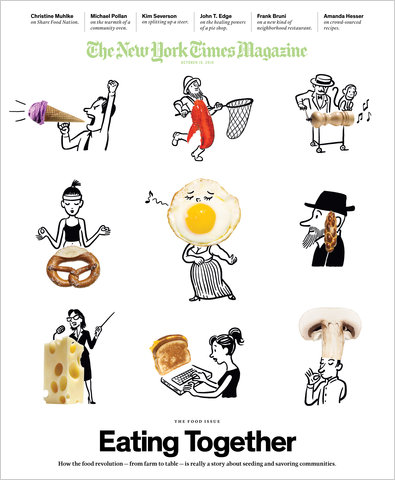
This week the entire NYTimes Magazine was devoted to "Eating Together." As I read about the various communal dining experiences highlighted - Blacks and Jews in Crown Heights, top-rated potluck recipes, group cooking in cob ovens Berkeley - I realized that the Times had finally caught on to one of the biggest lessons I learned after I left New York: there are never too many cooks in the kitchen.

When I first arrived in Seattle I was surprised by how many potluck meals I was invited to attend. Insecure about my cooking skills I often opted to bring a bottle of wine instead. But the invitations continued. Some weekends I was invited to several, so that I found myself in the kitchen, preparing the equivalent of an entire meal in order to be a guest at other peoples' homes. This seemed outrageous to me at the time. In New York I would have thought it terribly rude to be invited to someone's home and asked to bring a dish. Seattle was different.

Two years later I regularly host large potluck meals and am consistently amazed at the variety of ingredients and flavors and courses that my friends come together to create. Without having to police my guestlist, I never have too many quinoa dishes or too few desserts or not enough wine. If I were to measure my success at building community here by the quality of my potlucks, I would be quite impressed. And in fact, I am. The only greater satisfaction comes from preparing and cooking a meal with others, something I could have never done in New York if for no other reason than that the kitchens are too small. Because a meal cooked with others is, I believe, the most gratifying kind.

My first experience is communal cooking was in Whole Foods Production class during my first year at Bastyr. Sharing a kitchen station with three classmates, we divided up the weekly tasks of chopping, mincing, sauteeing, braising and searing. We then gathered around a table to enjoy the meal together, commenting on the flavors and colors, noting what was surprising, what could be done differently next time. We would share the cleaning responsibilities and part ways, off to class or work. But something about that time spent cooking together, swapping stories and ideas, forged a closeness that would be hard to create otherwise. I've had the fortune of taking several cooking classes since then and have found that experience replicated each time. That's why Michael Pollan's description in today's magazine strongly resonated with me.
It is a long, loquacious and delicious dinner, made more special by the fact that virtually everyone at the table had a hand in preparing it. I feel as if I’ve already learned a lot cooking with this crew, especially about working together and trading ideas. Each dish might have a lead cook, but other cooks will contribute a technique or flavoring — dozens of tasting spoons have been passed around — so that the final product becomes something more or less new, even to its author. Already I’m better acquainted with everyone in the easy way that seems to happen when people work together, especially at tasks, like kitchen prep, that leave plenty of mental space for talking. The flow of conversation has been desultory, drifting from summer plans to the World Cup (playing earlier in the living room), kids, other meals, the work at hand. But it is the working together at less-than-all-consuming tasks that seems to be forging our motley crew (far flung in age and background) into something that feels like a community. Sometimes getting to know people is easier done side by side than it is face to face.

This is nothing new. Having read and seen Like Water for Chocolate I recognized that this existed in other cultures, but American kitchens seemed different. Just a few years ago I remember reading a very different piece in the New York Times, one that described the alpha cook. Based on restaurant models, the term referred to the person who gives the orders, who bullies around the others in the kitchen. A restaurant owner and alpha chef interviewed in the piece stated that "Couples cooking together is probably the second leading cause of divorce next to home renovations.”

Communal cooking is different. It requires flexibility and room for individual autonomy. It is something I have grown to love and live on a regular basis. I knew I wanted to date my now boyfriend after we spent a night baking together. For my birthday I spontaneously invited some friends to bring the random and rather scant contents of their fridges over after a yoga class and we somehow managed to create a magnificent spread that amazed us all. I still have the opportunity to cook meals with classmates at school, but have expanded to working with volunteers for Teen Feed and with homeless youth at Street Youth Ministries as well.

I am just like everyone else, often too tired to prepare a meal and would more likely grab a quick snack. I find that I am more inclined to cook with others. Dividing up the work the process goes faster, and with some conversation or music the experience is more enjoyable. And when there are multiple chefs in the kitchen I am certain that the food tastes better too.

Sunday, October 3, 2010

Back to the Bubble

Last week was back to school week for me. Time away from the "Bastyr Bubble" was much needed but it's great to be back in a place that gives me constant food for thought, not to mention amusing blogworthy fodder. Here are some of the things that have entertained me this week and some of the reasons I'm happy to be back on campus:

1. Chard cards, our clever new school ID and cash cards. If you don't know what chard is, well, you probably don't go to Bastyr.
2. Neuro drinks. Someone left an empty bottle of this laying around in the hallway and I had to find out more. Turns out it's a line of functional energy drinks that supposedly enhance sexual health, mental health, and aid with sleep, weight loss and depression. I did read a review of these drinks that touted some real effects, which honestly seemed like reason for concern. But the effects seem to be short-lived: just long enough for you to develop an unhealthy addiction to these sweetened drinks. I guess the real issue is this - you want to make sure not to mistakenly drink a bottle of NeuroGasm instead of NeuroSonic before a big exam. (I strongly recommend spending some time on their website for some amusing videos.)
3. Lunchtime garden sales. My school has a magnificent garden that grows medicinal herbs and vegetables. Many of the herbs are used in botanical medicine and cooking classes. Some of the produce is donated to a local food bank, while some is sold during lunch. Coming home with bright green collard greens is better than just coming home with a whole lot of homework.

4. Food for Fines. Before the summer I took out Oliver Sack's The Man Who Mistook His Wife for A Hat from the school library. Then I traveled and forgot to return it for quite some time. I found a notice from the library in my box letting me know that I can pay off my overdue fines by bringing in non-perishable food items to be donated.

5. Class! I am very excited to be taking some really cool classes this quarter, including Contemporary Nutrition: Global/Ecological Aspects, a fascinating class that I think may steer this blog in another direction, and The Art of Eating, a joyful class about the life and work of M.F.K. Fisher, a renowned food writer. In a few weeks I may change my tune, but that would likely be under the duress of a heavy workload. In the meantime I will celebrate the intellectual stimulation that this quarter promises to deliver.

Monday, September 27, 2010

An Apple A Day

I could see the glimmer in my mother's eyes when I started taking nutrition prereq a few years ago. I enjoyed the dreaded organic chemistry and biochemistry classes and I knew what she was thinking - hoping what every cliche tells us a Jewish mother wishes for her child - that I would become a doctor. I told her and anyone else who suggested it that I would not become a doctor. I need my sleep, I faint every time I give blood and though I do not seem to be in a hurry to finish school, I was not about to embark on the long, demanding road to medical school. Nutrition would suffice. As though I were settling. In fact it was a very calculated decision - perhaps the most reasonable and rational one I've made to date. I wanted to change the face of public health and quality of life in the easiest, most basic way possible through an understanding of how the body works in order to address the root problem of most preventable illness while still allowed to maintain my own health and sanity. Well, most of the time. I figured that if everybody eats there would always be a need for health care providers to guide those eating decisions.

No, mom I will not be a doctor. I have not studied anatomy and physiology in the same detail, I have not focused as much time and attention on pathologies and diagnoses (though sometimes watching House I pretend). But I do know a good deal about food, cooking and nutrition and according to a recent article in The New York Times, most doctors cannot say the same. Though there is increasing recognition in the medical community that diet is linked to health, few doctors are equipped to discuss this with patients. This is where dietitians and nutritionists should be acknowledged as filling in the crucial missing link in preventative medicine and chronic disease management.

Ask most doctors why "an apple a day keeps the doctor away" and I wonder what they might say. Ask a nutrition expert and they'll tell you that apples are low in calories, a great source of fiber and they are naturally rich in phytochemicals like quercetin, one of the current darlings of the dietary supplement world. Eating apples can keep you healthy and hopefully out of the doctor's office. I wouldn't go so far as to suggest that the AMA removed a focus on nutrition from med school curricula to keep patients sick and business booming (though a more cynical conspiracy theorist might make that argument). I imagine there is only so much time and over the years the emphasis has shifted to treating conditions rather than root causes. I think that doctors today are overworked and stuck in administrative and financial battles with insurance companies and have less and less time to spend with patients. And I think that they might appreciate a future nutritionist like me easing their patient load with little bits of advice like this: it's apple season (in WA and NY!) so do yourself a favor and go apple picking, make a salad or dip your apples in some honey or caramel and have a sweet year ahead!

Wednesday, September 22, 2010

Tweets and Sweets, Fat and Friends

In college I loved sociology classes. Sociology of mass communication and pop culture, the American Jewish community, movies, religious fundamentalism. I took so many that I graduated with an obsessively critical mind and minor in sociology. If I were in college today I imagine I'd be registered for a course this fall on the sociology of social networking.

Social networking just barely existed when I was an undergraduate ten years ago. I first registered for Facebook as a graduate student at NYU when I learned that my sister Leigh's friend had posted pictures from Leigh's wedding on the site. I wanted to see them and I still had a .edu email address so I created an account. For the first six months I had about 5 friends, all college-age younger siblings of my real life friends. Then something changed. Maybe the right people had signed up and made it desirable and acceptable for skeptics and cynics to join or maybe it was when the site allowed non-students to sign up, but Facebook hit a tipping point. The initial excitement (I found my kindergarten crush! That guy who sat behind me in Spanish class! My friends from study abroad!) soon turned to public outcry (My mother joined Facebook! My boss, my teacher, my students!) The ongoing battle began - to secure privacy policies and allow access to a select few (hundred) people so that your potential employers did not come across your spring break photos from Cancun, 2003. The culture of Friendster, MySpace, Facebook, of Twitter has changed the way we live and the way we relate. It's not surprising then, that it has also affected our health.

This week an article in The New York Times addressed the use of social networks to tackle public health problems.

...how do we extract information from existing social networks to improve public health?

One method is to identify social connectors, people who spend time with more friends than average — and are thus exposed to more germs and are more likely to be among the first to contract contagious diseases like the flu. If health officials could find and track those social butterflies, they could tap into an early-detection system for epidemics and figure out whom to vaccinate first in order to slow the spread of disease.


This suggests a way to use social networks for control of infectious disease. But what about other health conditions? Last year The New York Times magazine featured an article, "Are Your Friends Making You Fat?" The answer, they found, was not only are your friends making you fat, but so are your friends' friends. The Framingham Study, conducted by the National Heart Institute, began in 1948 and over the years ithas become an important longitudinal study of heart disease by assessing biometrics, risk factors and other confounding factors. It was noted that healthy participants influenced one another in a way that benefited weight and overall health. It turns out that obesity, smoking, happiness can all be contagious. And no system lends itself to social contagion quite like the internet, where information can go viral. So does that mean it's time to go through your 537 Facebook friends and unfriend the fat ones? Perhaps if they update their status every day with messages like: Blankety McSo-and-So had the most decadent and rich slow-churn homemade ice cream sundae and can still taste the hot fudge on my lips. Go to your freezer and indulge too!" or "Lazy Johnsondecided that staying home and a seven hour Glee marathon was a far better idea than getting any sort of physical activity. Singing along on the couch is exercise too, right?" If reading these posts will influence your own behavior, then maybe unfriending (or at least hiding them in your feed) is a good solution. Or try the diet that encourages participants to broadcast every calorie and morsel they ingest. It worked for these people. (For those not interested in disclosing their food habits publicly there is a calorie-counting iPhone app to track food intake.)


I'm thinking about this today as two old friends from New York arrive for a weekend visit. Last time they visited they were afraid that I would force them to eat kale. As we spent time together cooking and eating they were realized that I enjoyed food that tastes good. This time around they know the drill. One is excited to go hiking again, the other is eager to walk around the lake. "I think I lost weight when I came to you last time," one offered. The other recalls tasting quinoa for the first time, and loving it. As for me, I'm looking forward to taking time to talk and laugh with old friends...cuz laughter is contagious too.